

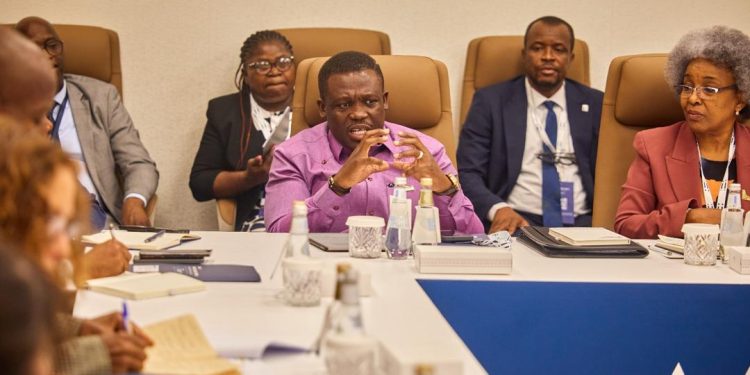
Minister for Communication, Digital Technology and Innovation, Samuel Nartey George, has advocated for an African-centred approach to the development and deployment of Artificial Intelligence (AI), emphasising the need for African values, data, computing infrastructure and human expertise to be adequately represented in the global AI ecosystem.
Speaking at the ongoing UNESCO Global Forum on the Ethics of Artificial Intelligence in Riyadh, Saudi Arabia, the Minister said Ghana’s experience with the UNESCO Readiness Assessment Methodology (RAM) had enabled the country to identify key strengths and gaps as it implements its 10-year National AI Strategy.
He explained that the assessment had provided a foundation for developing an implementation framework to build on existing capabilities while addressing critical areas that require further investment and development.
Mr George also stressed that conversations around AI ethics should extend beyond technical issues to consider the values embedded in AI systems. He noted that since ethical standards are influenced by values, there is a need to examine whose values are represented in AI models developed and deployed around the world.
The Minister expressed concern that some AI systems may not adequately understand or recognise African cultural practices because they have not been sufficiently trained on datasets that reflect Africa’s diverse cultures and experiences.
He cited what he described as a typical example where an AI model could classify a Western woman in a bikini differently from an African woman participating in a traditional cultural rite, potentially labelling the latter as nudity. The Minister said such outcomes highlight the danger of developing AI systems without adequate representation of African data, culture and traditions.
He therefore called on UNESCO to play a leading role in ensuring that African values and perspectives are adequately represented in the development of global AI ethical standards. Samuel Nartey George also drew parallels with social media governance, questioning the extent to which global community standards reflect African cultural values. He argued that Africa must have a stronger voice in determining the standards that will govern emerging technologies.
Africa Must Invest in Computing Infrastructure
The Minister further called for increased investment in computing infrastructure and human capacity across the African continent. He said Ghana was committing US$250 million over the next two years towards the development of AI computing infrastructure but stressed that the investment was not intended to serve Ghana alone.
Ghana, he explained, could become a regional computing hub that provides access to high-performance computing resources for neighbouring countries, universities, researchers and technology start-ups. “We’re not building for Ghana. Ghana is just 35 million people. We’re building that infrastructure with a mindset of Africa as a continent,” he said.
He said African countries should avoid a situation where every country attempts to independently establish expensive computing infrastructure, which could put additional pressure on the continent’s already constrained power systems. Instead, he advocated the development of regional infrastructure hubs that can serve multiple countries.
Under such an arrangement, he said, countries such as Liberia, Sierra Leone, Guinea, The Gambia and others could access computing infrastructure hosted in Ghana, while contributing to and benefiting from the ecosystem. The Minister said such an approach would allow African researchers and start-ups to access computing resources that are more affordable, sovereign and located on the continent, rather than depending entirely on infrastructure hosted outside Africa.
One Million Coders Programme
“On human capital development, Samuel Nartey George highlighted Ghana’s investment in building the skills needed to operate and govern emerging technologies. He referenced the government’s One Million Coders program, which aims to train one million Ghanaians in future-focused digital skills. The initiative extends beyond coding, offering training in artificial intelligence, data security, and cybersecurity.
He explained that the program is being expanded into secondary schools in collaboration with the Ministry of Education and has already partnered with universities nationwide. AI-related courses are now integrated into university curricula, with students in 20 major institutions required to complete designated AI courses as a graduation prerequisite.
‘If you don’t do it, you don’t graduate,’ the Minister emphasised, underscoring the government’s commitment to cultivating a critical pool of AI-skilled professionals. He further revealed that, in partnership with the United Nations Development Programme (UNDP), Ghana has trained all Chief Directors—equivalent to Permanent Secretaries in some jurisdictions—in AI skills, with training now being extended to directors and assistant directors across the civil service.
He stressed that government officials overseeing AI deployment must themselves possess the knowledge and expertise necessary to effectively regulate and manage the technology
Ghana Pushes for African Consensus
Looking beyond Ghana, Samuel Nartey George called for a unified African position on AI governance, digital infrastructure and the continent’s engagement with major global technology companies.
He said Ghana’s forthcoming leadership roles within the African Union (AU) would provide an opportunity to promote a collective continental agenda on artificial intelligence and digital technologies.
According to the Minister, Ghana is expected to assume the AU chairmanship from February next year, while he is also expected to chair the AU Specialised Technical Committee on ICT and Communications. He said these positions could serve as platforms for building consensus around Africa’s priorities and strengthening the continent’s bargaining power in engagements with major global technology firms.
Mr George noted that individual African countries might have limited influence when negotiating with companies such as NVIDIA and Huawei, but a united continental position through the AU would give Africa greater leverage.
“Ghana alone cannot bring Nvidia or Huawei to the table to meet our position. But when we take a collective position as Africa, then we can have a voice at the table through the African Union,” he said.
The Minister also commended UNESCO for creating a platform that enables countries to deliberate on the ethical, technical and developmental implications of artificial intelligence.
He reaffirmed Ghana’s commitment to working with UNESCO, the African Union and other international partners to promote AI development that reflects Africa’s interests while supporting inclusive and sustainable development across the continent.

