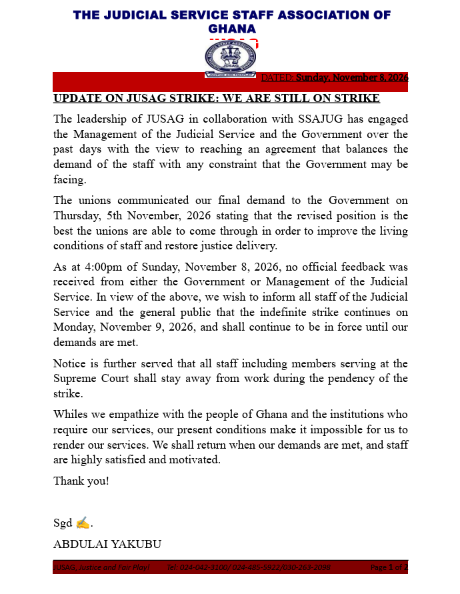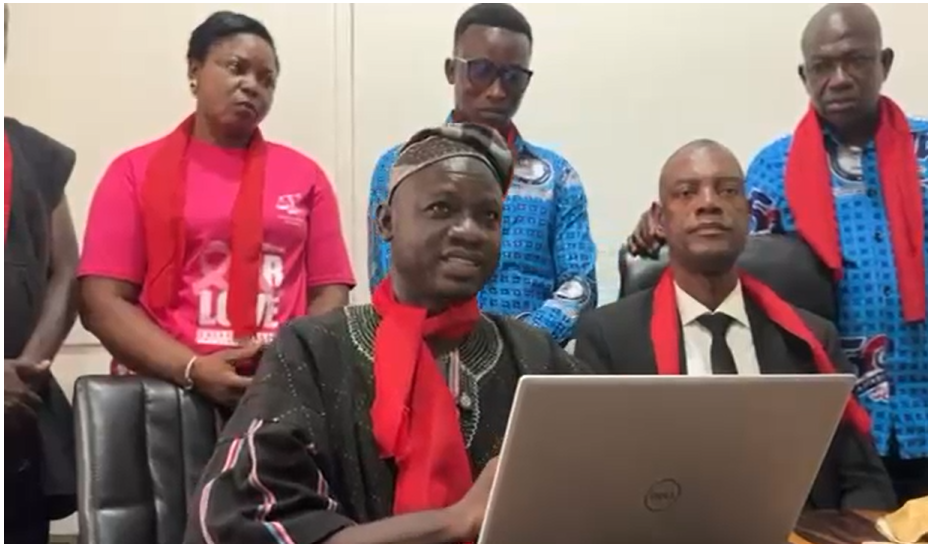
The Judicial Service Staff Association of Ghana (JUSAG), in collaboration with the Senior Staff Association of the Judicial Service of Ghana (SSAJUG), has extended its indefinite nationwide strike, directing all Judicial Service employees, including staff of the Supreme Court, to remain at home from Monday, November 9. The decision follows the government’s failure to respond to the unions’ revised demands, despite several engagements with Judicial Service Management and government officials aimed at resolving the impasse.
In a statement issued on Sunday, November 8, the unions disclosed that they submitted their final position to the government on Thursday, November 5, after making concessions to accommodate what they described as the government’s financial constraints. However, they said neither the government nor Judicial Service Management had provided an official response as of 4:00 p.m. on Sunday.
“The revised position is the best the unions are able to come through in order to improve the living conditions of staff and restore justice delivery,” the statement said. The unions maintained that the industrial action would continue indefinitely until further notice, emphasising that all Judicial Service employees, including those at the Supreme Court, must comply with the directive.
The strike, which commenced on November 2, was triggered by delays in approving and implementing revised salaries and conditions of service for Judicial Service employees, as well as outstanding salary arrears covering January to October 2026. Among their initial demands, JUSAG called for presidential approval of the Judicial Council’s recommendations on the 2026 salary review, implementation of the revised salaries in November, and payment of all outstanding arrears.
In response, the government approved the implementation of the new conditions of service, effective January 1, 2026, and announced plans to settle the arrears in two instalments. The first instalment was expected to cover January to May, while the second would cover June to October.
Despite the government’s intervention, the unions have maintained that the proposed arrangements do not adequately address their concerns. They insist that all outstanding issues relating to the revised conditions of service must be resolved before they will consider calling off the strike.
The unions apologised to Ghanaians and institutions affected by the disruption of judicial services but reiterated that their members would not return to work until their demands were fully addressed and adequate measures put in place to improve staff welfare and motivation.