
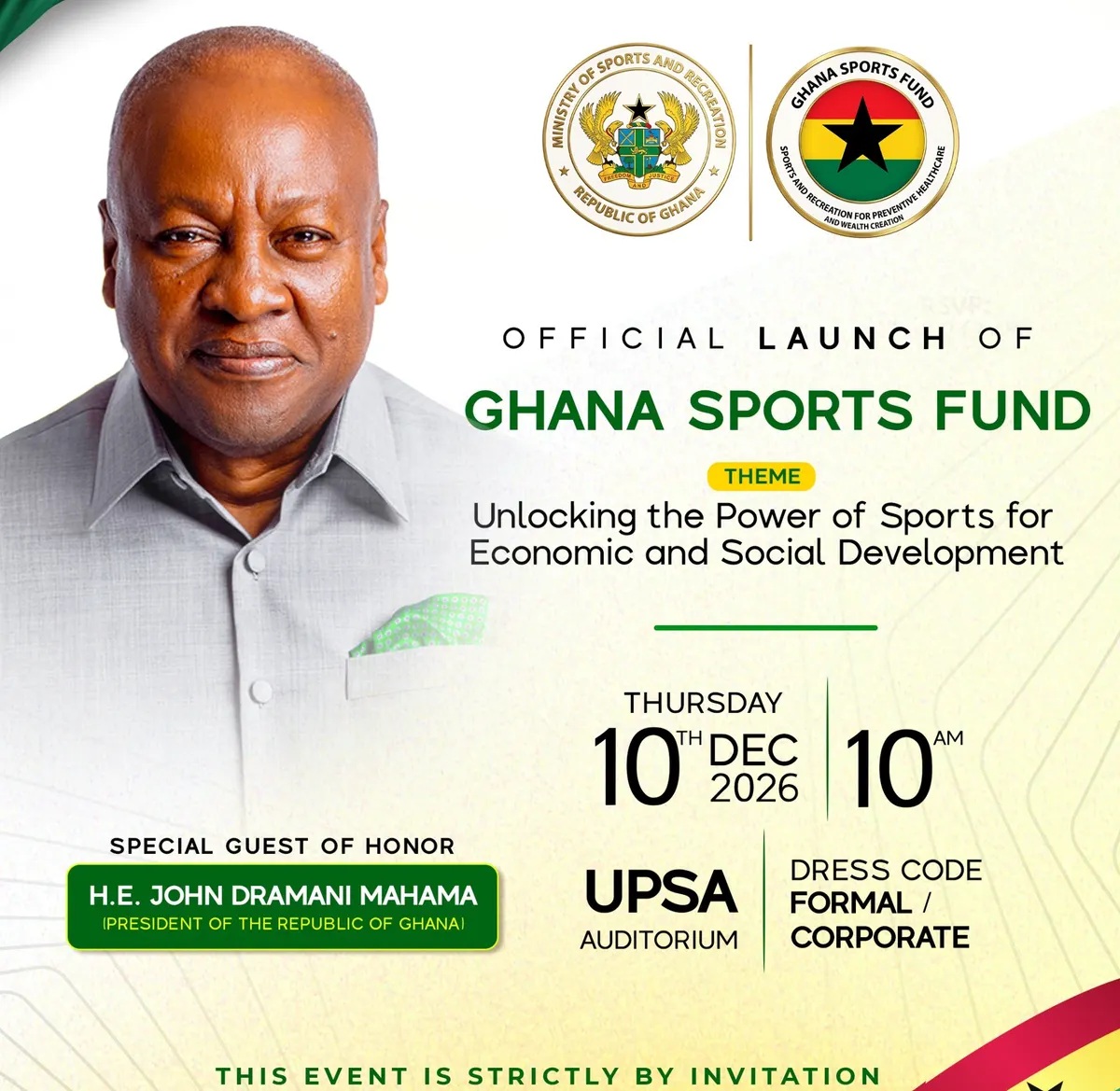
President John Dramani Mahama is expected to attend the official launch of the Ghana Sports Fund on December 10, 2026, at the University of Professional Studies, Accra (UPSA), in a landmark development aimed at securing sustainable financing for sports development in Ghana.
The launch will formally unveil an initiative designed to address the longstanding challenge of inadequate and inconsistent funding in the country’s sporting sector. The event is expected to attract key stakeholders from government, sports administration, the corporate sector and the media, following extensive consultations to build consensus on the Fund’s implementation, governance structure and long-term sustainability.
The establishment of the Ghana Sports Fund marks the culmination of an initiative that has been in the making for approximately nine years. Its legal foundation was established through the Ghana Sports Fund Act, 2025 (Act 1159), which provides the framework for mobilising, managing and distributing financial resources to support sports development across the country.
The Fund is expected to invest in several priority areas, including athlete welfare, grassroots sports development, infrastructure, coaching, capacity building and preparations for major international competitions. With operations extending across all 16 regions of Ghana, it seeks to strengthen the country’s sporting ecosystem and create sustainable development opportunities for athletes, coaches and sports administrators.
The Fund is overseen by an 11-member Board of Directors chaired by Professor Koryoe Anim-Wright. The Board brings together representatives from government institutions, sports administration, the investment sector and the wider sporting community.
Its membership includes the Chief Director of the Ministry of Sports and Recreation, Mrs Wilhelmina Asamoah; Director-General of the National Sports Authority, Prof Emmanuel Osei Sarpong; investment banker Ernest Thompson; and former world boxing champion Azumah Nelson, who represents the athletes’ fraternity.
Other members are Mr Duah Alhassan Oteng, Ms Deborah Adei Djanie, Ms Belinda Plange, Hon Rachel Florence Appoh and Hon Dickson Kyere-Duah. The Board is mandated to provide strategic leadership, approve budgets and ensure transparency and accountability in the mobilisation, allocation and utilisation of the Fund’s resources.
The day-to-day operations of the Fund are headed by Dr David Kofi Mawuvi Wuaku, who serves as Administrator, assisted by Simon Appiah, Esq, as Deputy Administrator. Dr Wuaku, a banking and finance professional, is expected to play a pivotal role in ensuring that resources generated are prudently managed and channelled into programmes capable of delivering meaningful results for Ghanaian sports.
Speaking on the broader importance of the initiative, Dr Wuaku has underscored the role of sports investment in national development, particularly in promoting public health and creating economic opportunities. “Sports is preventive healthcare. When we invest in sports, medical bills reduce. Beyond that, it is a source of wealth creation for the nation and the continent,” he stated.
He has further advocated increased recognition of sports in national budgetary allocations, stressing the importance of sustained financial commitment rather than depending on occasional government interventions, donations and other short-term funding arrangements.
Over the years, Ghana’s sporting sector has faced persistent challenges, including inadequate funding, infrastructure shortfalls, limited athlete welfare provisions and difficulties in maintaining long-term development programmes across various sporting disciplines. These constraints have often undermined preparations for international competitions, while several national sports federations have struggled to implement comprehensive development strategies.
Against this backdrop, the Ghana Sports Fund is expected to introduce a more structured and coordinated financing mechanism by attracting contributions from government, corporate institutions, individuals and development partners. In addition to supporting elite athletes and national teams, the Fund is expected to strengthen grassroots talent identification, improve sporting infrastructure, enhance coaching standards and establish a more competitive high-performance sports environment.
As part of efforts to ensure a smooth and effective rollout, the Fund’s leadership has undertaken stakeholder engagements to solicit input on its proposed regulations and operational guidelines. At a stakeholder consultation held on November 13, 2026, representatives of sports federations and other relevant institutions met with the Fund’s leadership to deliberate on the proposed regulations for implementing Act 1159.
Key issues discussed included the Fund’s objectives and scope of application, athlete welfare, monitoring and evaluation mechanisms, accountability arrangements and procedures for resolving grievances. The consultation provided an important platform for stakeholders to offer recommendations towards developing an inclusive, transparent and efficient operational framework that adequately reflects the needs and expectations of the sporting community.
The Minister for Sports and Recreation, Kofi Iddie Adams, has consistently emphasised the need for the Fund to operate in the best interests of sports development, with transparency, accountability and prudent financial management serving as its guiding principles. Similarly, Board Chairperson Professor Anim-Wright has stressed the importance of translating the initiative into measurable improvements in sports infrastructure, athlete development pathways, governance systems and overall sporting performance.
The December 10 launch at UPSA is expected to offer the Fund’s leadership an opportunity to formally present its vision, objectives, implementation strategy and operational framework to the public. With President Mahama expected to grace the occasion, the event is set to mark an important milestone in Ghana’s efforts to establish a dependable and sustainable financing structure for sports development.
Ultimately, the success of the Ghana Sports Fund will be measured by its ability to close the country’s sports funding gap, attract meaningful private-sector investment, improve athlete welfare, strengthen institutional capacity and enhance Ghana’s competitiveness at continental and international levels.

