
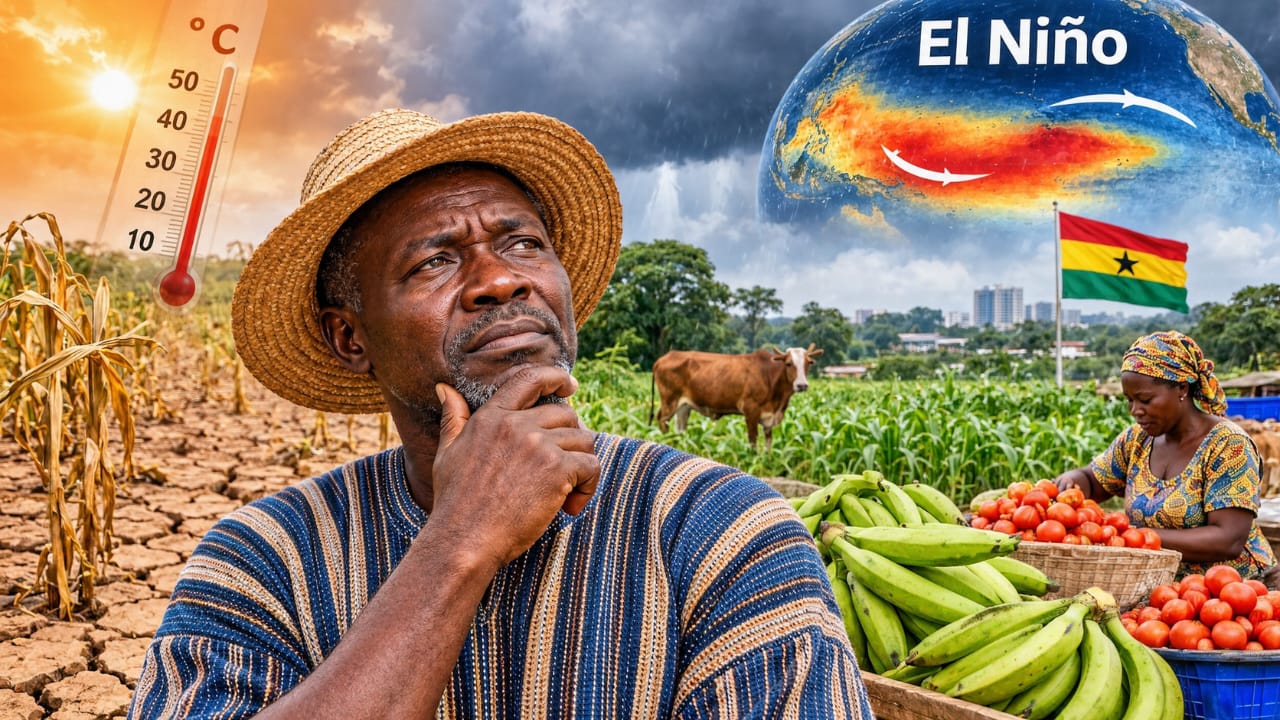
Agriculture has always been an economic activity deeply influenced by the forces of nature. However, increasing weather unpredictability is fundamentally altering the conditions under which agricultural production takes place, with significant consequences for agribusiness profitability, investment decisions and rural livelihoods. During a project review meeting, an agricultural insurance broker once made an observation that has stayed with me: “Farming is the most unequal bet in human existence.
The farmer risks almost everything, while nature risks nothing in the wager.” I often recall these words when reflecting on Ghana’s agricultural sector, where farming remains fundamental to employment, household incomes, national food security, foreign exchange earnings and the supply of raw materials to industry.
Climate variability is no longer merely an environmental issue. It has become a significant production risk, an investment risk, a market risk and, ultimately, a livelihood risk. This makes the developing El Niño phenomenon particularly important. El Niño is a naturally occurring climate phenomenon associated with the warming of the central and eastern equatorial Pacific Ocean.
This warming influences atmospheric circulation and can alter rainfall and temperature patterns across different parts of the world, including West Africa. However, its effects vary across countries and geographical regions, making location-specific climate information essential for effective planning and decision-making.
As World Meteorological Organization Secretary-General Celeste Saulo has noted, the phenomenon “offers governments and people an opportunity to anticipate risks and act before impacts manifest”. This observation underscores an important point: the real value of climate information extends beyond forecasting potential weather conditions.
It lies in translating forecasts into timely decisions that enable individuals, institutions and businesses to prepare for and manage emerging risks. In this regard, the Ghana Meteorological Agency (GMet) has warned that a very strong El Niño event developing in the Pacific Ocean could influence Ghana’s weather conditions into the first half of 2027.
According to GMet, there is an 83 per cent probability that the event will attain strong to very strong intensity during the January–March 2027 period. Potential implications for Ghana include hotter, drier and dustier conditions during the dry season, prolonged dry spells and increased heat stress.
The possibility of episodes of intense rainfall and localised flooding, particularly across parts of southern Ghana, also remains. These projections warrant particular attention because a considerable proportion of the country’s agricultural production remains dependent on rainfall. Many smallholder farmers also face significant constraints in accessing irrigation infrastructure, reliable and timely climate information, appropriate production technologies and affordable finance.
Consequently, prolonged dry spells and rising temperatures could expose farmers and other agricultural value-chain actors to heightened production and commercial uncertainty. The critical question, therefore, is not simply whether El Niño will bring reduced rainfall or higher temperatures. Rather, it is how the associated climatic pressures could affect agricultural productivity, business profitability, investment decisions and rural livelihoods in Ghana — and, more importantly, what innovations, institutional arrangements and financial solutions can strengthen the capacity of the agribusiness sector to anticipate, withstand and respond to these risks.
The effects will not be the same everywhere.
Ghana has experienced very strong El Niño events in 1982/83, 1997/98 and 2015/16, as well as a moderate event in 2023/24. These episodes demonstrate the country’s exposure to rainfall variability and its consequences for agriculture, water resources, hydroelectric power generation and public health.
However, El Niño does not automatically mean that every farming community will experience drought. Climate information must be interpreted at regional, local and, where possible, farm-specific levels. The vulnerabilities of communities in the northern, transition and southern agroecological zones should guide the timing and nature of preparedness measures.
There is already evidence of how dry spells affect crop productivity in Ghana. A scientific study examining dry spells exceeding seven days during the mid and late growth stages of early-maturing maize, millet and sorghum reported yield reductions of 36 per cent, 25 per cent and 23 per cent, respectively, in northern Ghana. Rice production can also suffer substantial losses when water becomes scarce, particularly under rain-fed systems.
Although cassava and yam are relatively more tolerant of dry conditions than many cereal crops, they are not immune to prolonged moisture stress. Plantain production is also vulnerable: moisture deficits can affect bunch formation and fruit filling, reducing yield and marketable quality.
For perennial crops such as cocoa, heat and moisture stress can affect tree health, flowering, pod development and productivity. In livestock production, reduced rainfall and higher temperatures can affect pasture regeneration, water availability and animal comfort. Poultry may also experience reduced feed consumption, growth performance and egg production under heat stress.
The consequences extend beyond lower harvests.
Farmers and agribusiness operators may have to spend more on irrigation, water management, labour and supplementary animal feeding simply to sustain production. Yet higher expenditure does not necessarily produce higher output or better returns. A farmer may invest more in irrigation and labour but still harvest less because of prolonged moisture stress.
If market prices do not compensate for the additional costs, profit margins become narrower. For smallholder households with limited financial reserves, reduced yields and farm income can affect food consumption, children’s education, access to healthcare, savings, asset accumulation and overall wellbeing. Adaptation is therefore not just a matter of having technology available. Farmers must also be able to afford, access and use it effectively.
And the pressure does not end at the farm gate.
Rising temperatures make effective post-harvest management increasingly critical, particularly for highly perishable commodities such as tomatoes, pepper, leafy vegetables, fruits and plantain. In the absence of appropriate harvesting, handling, transportation and storage systems, higher temperatures can accelerate spoilage, reduce the period within which produce can be marketed and increase post-harvest losses for farmers and traders.
A KNUST study referenced in this discussion indicates that plantain has a maximum storage period of just three to seven days. The study also reportedly found that 52 per cent of bulk plantain merchants lacked adequate storage facilities or appropriate storage technologies. These merchants source fresh plantain bunches from production and trading centres such as Goaso, Sankore and Juabuso.
These findings reveal an important dimension of agricultural vulnerability: even after successfully sourcing and purchasing produce, traders remain exposed to significant financial losses when appropriate storage infrastructure is unavailable.
The implications of declining plantain production and poor post-harvest management extend well beyond the farm gate, affecting processors, bulk purchasers and urban food markets. Consider the experience of traders such as Mary Gyamfua, who transports plantain from farm gates to markets in Ashaiman and Tema Community One. For traders operating under these conditions, unpredictable supplies, deterioration in produce quality and fluctuations in fuel prices can compound operating costs, erode profit margins and undermine business viability.
Climate resilience must therefore be approached as a value-chain-wide concern rather than an issue confined to agricultural production. Farmers, aggregators, traders, transport operators, processors and other market actors all face climate-related risks that can threaten their businesses and livelihoods. Strengthening resilience across the entire agricultural value chain is essential to reducing losses, protecting incomes, stabilising food supplies and sustaining the commercial activities that connect rural producers to urban consumers.
Consumers, too, can feel the cost of adaptation.
During the prolonged dry spell of 2024, I stopped at Duampompo, near Konongo, along the Accra–Kumasi highway, to buy some boiled maize. I asked the seller whether she could offer me a discount, but she declined. Her response was both intriguing and revealing: “This is motorized maize.”
What she meant was that the maize had been cultivated using irrigation, and the cost of pumping water had been factored into its selling price. Although expressed in a simple, everyday phrase, her explanation captured an important economic relationship: climate stress can increase agricultural production costs; adapting to these conditions requires additional investment; and some of these costs are eventually transferred to consumers. The maize was available, in part, because someone had invested in irrigation to sustain production despite unfavourable weather conditions. For the consumer, adaptation translated into continued access to food, albeit at a higher price.
This experience highlights a broader challenge for Ghana’s agricultural sector. Irrigation, mechanisation and other climate-resilient technologies are increasingly indispensable, yet farmers and agribusiness operators do not have equal access to the resources required to invest in and adopt them. Those with limited financial and technical capacity risk being left behind, while consumers may ultimately absorb part of the additional production costs through higher food prices.
Ghana must therefore move beyond simply encouraging farmers to adopt climate-resilient technologies. The priority should be to establish the institutional, financial, technological and market conditions that make adaptation accessible, affordable, commercially viable and sustainable. Climate resilience must be viewed not merely as an agricultural production imperative, but also as an investment in agribusiness profitability, dependable food supplies, consumer affordability and the protection of rural livelihoods.
In Part Two, I will explore practical pathways for strengthening agricultural resilience in Ghana, with particular attention to innovation communication, mechanisation-as-a-service, market intelligence, innovative financial instruments and anticipatory action.
The author of this piece is Ellison Owusu Fordjour. He is an Agricultural Innovation Communication Expert.

