
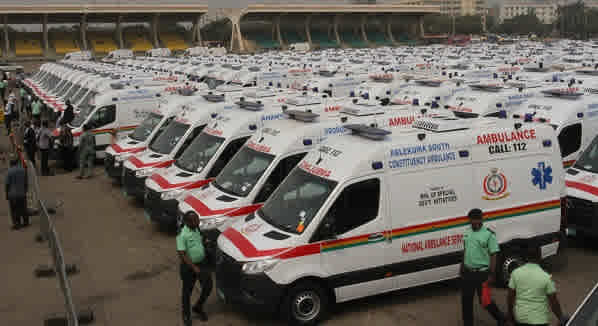
The National Ambulance Service (NAS) has defended its emergency response capacity following a GHOne TV investigation that showed several ambulances currently out of service. The Service explained that most of the affected vehicles are undergoing or awaiting major repairs due to accidents and mechanical faults, rather than being abandoned.
In a statement issued on Monday, September 21, 2026, in response to GHOne TV’s investigative report, “Ambulances at ‘REST’ – Assessing Emergency Medical Response in Ghana,” NAS acknowledged that part of its fleet is currently non-operational but stressed that it continues to provide services across all 16 regions.
The Service said the 307 Mercedes-Benz ambulances procured by the government in January 2020 have been in continuous operation for more than six years, often under heavy use and across challenging terrain.
According to NAS, the prolonged service has contributed to normal wear and tear, road traffic accidents and mechanical breakdowns. Some of the vehicles, it added, require specialised spare parts and extensive repairs before they can return to service.
“The images depicted largely represent ambulances involved in accidents and those awaiting major repairs at our central workshop, and not a general abandonment of the fleet,” the Service said.
NAS also acknowledged that, as with emergency response fleets in other jurisdictions, it is not possible to maintain 100 per cent vehicle serviceability at all times.
The Service said it is working with the Ministry of Health to accelerate the procurement of spare parts and establish regional maintenance centres to reduce the amount of time ambulances remain grounded.
Despite the challenges affecting its fleet, NAS said it responds to an average of more than 300 emergency cases daily across the country.
It further assured the public that its national emergency number, 112, remains operational 24 hours a day, seven days a week, while emergency medical teams continue to provide pre-hospital care nationwide.
The Service also highlighted efforts to strengthen the clinical competencies of its Emergency Medical Technicians (EMTs) through a comprehensive competency enhancement programme covering all cadres.
The programme includes training in areas such as intravenous (IV) therapy, which NAS said is aimed at addressing gaps identified through recent inquiries and improving the quality of emergency medical care.
NAS said it welcomes public scrutiny of Ghana’s emergency medical system, noting that such scrutiny can contribute to greater accountability and improved service delivery.
“We appreciate GHOne TV and the EIB Network for highlighting matters of public interest,” the Service said, adding that it would engage the media organisation to provide further clarification.
The Service, however, assured the public that it remains committed to delivering “timely, safe and efficient” pre-hospital emergency care despite the operational challenges affecting parts of its fleet.

