
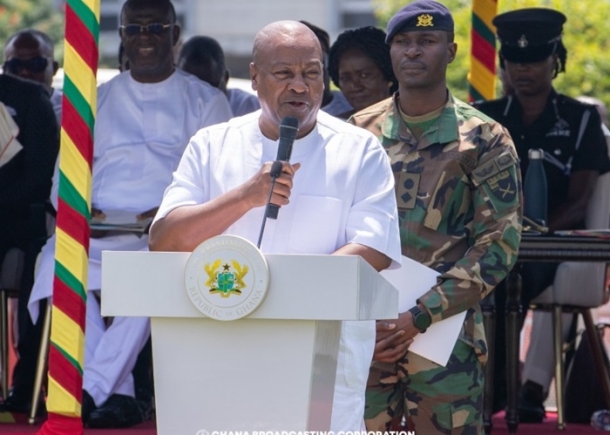
The government is targeting more than 50,000 beneficiaries for the next phase of the National Apprenticeship Programme, scheduled to begin next year, following the successful graduation of more than 13,000 young people under its pilot phase. The programme provides practical training across nine broad areas, including agriculture and agro-processing, artisanal trades such as carpentry and masonry, mechanical and electrical works, traditional crafts, catering, creative arts, fashion and textiles, beauty and personal care, renewable energy, hospitality and tourism, and information and communications technology.
Depending on the trade, the training period ranges from three to 18 months, with 70 per cent dedicated to practical instruction and the remaining 30 per cent covering theoretical lessons, including entrepreneurship training. Speaking at the maiden graduation ceremony in Accra yesterday, President John Dramani Mahama disclosed that women accounted for nearly 78 per cent of the graduates, significantly exceeding the programme’s 40 per cent female participation target.
He said the achievement reflected the programme’s growing contribution to youth skills development and efforts to expand opportunities for women. “Today belongs to the 13,309 young men and women who make up our first graduating class of the National Apprenticeship Programme,” he said.
The President commended the graduates for their commitment, noting that they had spent several months acquiring practical skills, developing their trades and gaining the confidence of their trainers. “You have spent months learning your trade, practising your skills, and earning your trainers’ confidence. Your families share in this achievement today,” he added.
Recalling the launch of the programme in Tamale on April 30 last year, President Mahama said the initiative was driven by his commitment to ensuring that financial constraints, family background or the inability to access university education did not prevent young people from securing decent livelihoods.
He explained that although the pilot phase was initially designed to train 10,000 young Ghanaians, it attracted more than 300,000 applications, highlighting the significant demand for vocational and practical skills training. A total of 14,335 apprentices were eventually enrolled, exceeding the initial target by 43 per cent, while 13,309 successfully completed the programme.
President Mahama praised the Ministry of Youth Development and Empowerment, the National Youth Authority (NYA) and the programme’s implementation team for successfully delivering the first cohort. He further noted that the initiative had expanded access to structured apprenticeship training across all 16 regions, ensuring that young people could acquire employable skills without necessarily travelling far from their communities.
More than 2,200 beneficiaries were trained in the Upper West Region, while the Northern Region recorded over 1,900 graduates. The Ashanti and Greater Accra regions each had more than 1,400 beneficiaries, with over 1,000 trained in both the Eastern and Upper East regions. Thousands of others were drawn from the remaining regions. “A young person in Nkoranza or Bawku should have a fair chance to learn a trade closer to home, just as a young person in Accra or Kumasi,” he stated.
Of the 13,309 graduates, 10,325 were females and 2,984 were males, representing approximately 78 per cent and 22 per cent, respectively. Despite the strong female participation, the President encouraged more women to venture into traditionally male-dominated occupations, including electrical installations, plumbing, welding, mechanical engineering, renewable energy, digital technology and carpentry.
“Let us not all go into bakery and sewing. You too can do it. You can become a plumber, you can become an electrician, you can become a welder,” he urged. President Mahama, however, expressed concern about the relatively low participation of persons with disabilities (PWDs), revealing that only 112 of the graduates were from that group, falling short of the programme’s minimum five per cent target.
He called for deliberate efforts to increase their participation in subsequent phases of the initiative. “We still have a lot of work to do in this regard. In the next cohort, I want to see an increase in the number of PWDs,” he said. Highlighting the programme’s practical approach to skills development, the President contrasted its hands-on training model with the predominantly theoretical structure of conventional education.
“In the National Apprenticeship Programme, they put a saw in your hand, and they put the wood on the table for you to cut,” he explained. As part of the support package, graduates received start-up kits and equipment tailored to their respective trades to enable them to establish businesses and become self-employed. The government also covered the cost of training by paying master craftspersons and provided apprentices with monthly stipends to cover their transportation throughout the training period.
“Government pays for the training to the master craftsman and relieves your parents of the financial burden. But most of all, we give you a stipend to be able to commute to work and back every day until you finish your training,” President Mahama said. To finance the expansion of the programme, the President disclosed that he had directed the Minister of Finance to uncap the Communication Service Tax to generate an additional GH¢1 billion to support the National Apprenticeship Programme, the Adwumawura Programme and the Youth Employment Agency.
He added that graduates interested in establishing their own businesses would be referred to the Adwumawura Programme to access start-up capital. The President further announced that companies registered under the 24-Hour Economy policy would be provided with a database of programme graduates to enable them to prioritise their recruitment.
He said participants seeking to advance their digital skills would also benefit from the One Million Coders Programme, while women who successfully completed their apprenticeships would receive priority support from the proposed Women’s Development Bank. President Mahama also revealed that Ghana had received requests from countries in the Caribbean and the Middle East seeking skilled workers, including welders and steel benders, for fixed-term employment contracts of approximately five years.
He added that, under the New Economy initiative, the government was investing US$10 billion over four years in eight strategic sectors to stimulate economic growth and create employment opportunities. The President called on private businesses, contractors and public institutions to support the graduates by providing employment opportunities, mentoring young artisans and engaging them as suppliers once they met the required standards. Addressing the graduates, he urged them to uphold professionalism, punctuality, honesty and proper business management in their respective trades.
“Take pride in the trade that you have learned. Be punctual, deal honestly with your customers and keep proper records,” he advised. Using the example of a baker, he stressed the importance of reliability and meeting agreed deadlines, urging graduates to ensure that customers received services and products at the promised time.
He also encouraged them to embrace innovation and emerging technologies to remain competitive and improve the quality of their work. For his part, Chief Executive Officer of the National Youth Authority, Osman Ayariga, urged the graduates to maximise the opportunities created through the programme, make effective use of the resources invested in their training and pursue available opportunities within their respective trades.

