
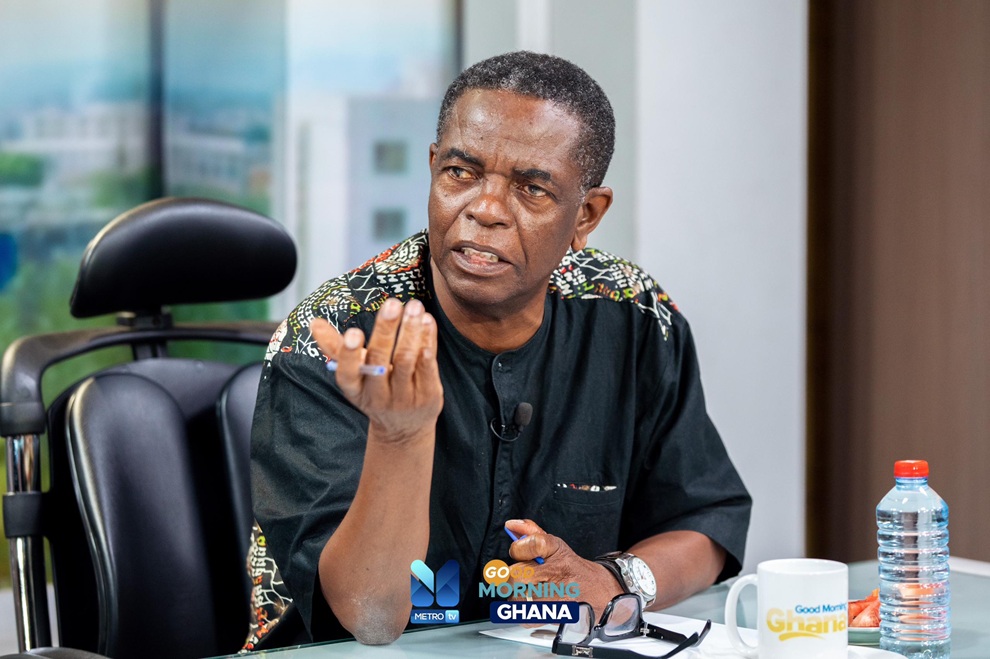
Veteran journalist and political commentator Kwesi Pratt Jnr. has criticised attempts to portray the Israeli-Palestinian crisis as a religious dispute, arguing that its roots lie in colonial occupation, apartheid, racism and the denial of Palestinian rights. He maintained that the longstanding conflict should not be interpreted as a clash between Christianity and Islam but rather as a struggle involving human rights, self-determination and the Palestinian people’s quest for national independence.
Speaking on Metro TV’s Good Morning Ghana during a discussion on Ghana’s support for United Nations resolutions on Palestine, Mr Pratt said viewing the crisis through a religious lens demonstrated a misunderstanding of its historical origins. He argued that the conflict did not begin with the October 7, 2023, Hamas attacks, stressing that tensions between Israel and Palestine had existed for decades before those events.
“There are actually people who see this as a Christian-Muslim conflict, and that’s garbage (sic). There are more Christians in Palestine than there are in Israel,” he stated. Mr Pratt also pointed to the Catholic Church’s public expressions of solidarity with Palestinians, saying religious affiliations could not adequately explain the crisis. He questioned why opposition to apartheid and racism should be influenced by geopolitical alignments, including whether one supported the United States or Russia.
“Now, how do you see questions of apartheid and racism from the point of view of whether you support America or you support Russia? It doesn’t make any sense. Every dissent society, every dissent people ought to be opposed to all forms of racism,” he argued. The veteran journalist further insisted that any meaningful analysis of the conflict must take into account its historical background, particularly developments dating back to 1947 and 1948.
He rejected attempts to use the October 7 attacks as the starting point for understanding the crisis, noting that the Israeli-Palestinian conflict had been ongoing for several decades. “And then there are those who erroneously traced the conflict to October 7th, three years ago. The conflict had existed for close to how many years, since 1948, 1947 and so on. You cannot begin to analyze the conflict from October 7th, three years ago,” he said.
Mr Pratt also cautioned against interpreting Ghana’s support for Palestine as a realignment of its international relationships or a departure from its diplomatic ties with the United States. He maintained that standing against racism and advocating Palestinian rights should be treated as matters of principle rather than viewed through the rivalry between global powers.
His comments follow commendation from the Embassy of the State of Palestine in Ghana for the country’s support for United Nations General Assembly resolutions on the Palestinian question. In a statement issued in Accra, the Embassy praised President John Dramani Mahama and the Ghanaian government for supporting resolutions relating to the renewal of the mandate of the United Nations Relief and Works Agency for Palestine Refugees in the Near East (UNRWA), the rights and properties of Palestinian refugees, and the legal consequences of Israeli settlement activities in occupied Palestinian territory.
The Embassy said Ghana’s position demonstrated its longstanding commitment to international law and the Palestinian people’s right to self-determination, freedom and independence. Welcoming the government’s stance, Mr Pratt called on the international community to sustain pressure for an end to the occupation and the protection of Palestinian rights. Ghana has consistently supported a two-state solution to the conflict, with President Mahama reaffirming at the 81st United Nations General Assembly that Israel and Palestine must be able to coexist peacefully and securely.

