

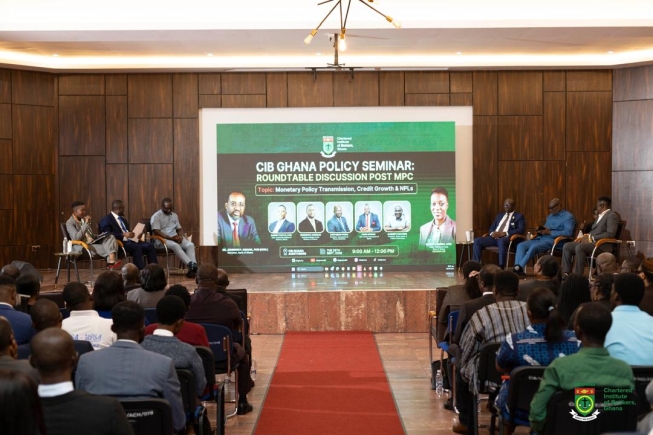
Lower interest rates are reaching borrowers from Ghana’s universal banks faster than those from community and microfinance banks. This finding comes from a survey of banks presented at the third Post-Monetary Policy Committee Policy Seminar of the Chartered Institute of Bankers, Ghana. The seminar, held at the CIB Ghana Auditorium and streamed on the Institute’s social media platforms, brought together representatives from the Bank of Ghana, the Ministry of Finance, various banks, traders, and industry stakeholders.
The discussions focused on monetary policy transmission, credit growth, and non-performing loans. This seminar followed the 132nd meeting of the Bank of Ghana’s Monetary Policy Committee, which voted unanimously on September 24, 2026, to maintain the policy rate at 14.0 percent.
Credit growth and credit quality
Opening the seminar, President of the CIB Ghana Governing Council, Dr Mrs Ellen Ohene-Afoakwa, noted that monetary policy extends beyond the realm of economists and central bankers, influencing financial markets, lending conditions, businesses and households through its transmission mechanisms. She explained that the success of monetary policy is determined not only by adjustments to the policy rate but also by how effectively those adjustments are passed on to the broader economy.
Dr Ohene-Afoakwa stressed that credit expansion must go hand in hand with sound credit quality. “As an institute, we recognise that credit growth and credit quality must move together,” she said. She further emphasised the need for a banking sector that can channel sufficient credit to productive sectors while upholding robust risk management and responsible lending standards. Addressing the issue of non-performing loans, she argued that greater emphasis should be placed on preventing bad loans from occurring rather than focusing primarily on recovery efforts after they have deteriorated.
Central bank perspective
In remarks delivered by the Bank of Ghana’s Director of Research, Dr. Simon Harvey, the Governor of the Bank of Ghana, Dr. Johnson P. Asiama, explained that changes in the policy rate do not immediately affect borrowers. This is because banks consider several factors when pricing loans, including funding costs, credit risk, operating expenses, and anticipated losses. “This transmission is neither automatic nor instantaneous,” the Governor stated.
He emphasised that the goal of monetary policy is not just to achieve lower interest rates, but to maintain anchored inflation expectations, a stable currency, and sound financial institutions. He also urged for a stronger emphasis on preventing non-performing loans. “The objective is not merely to achieve lower interest rates,” he noted. Additionally, the Governor mentioned that the committee found CIB Ghana’s Pre-MPC survey, provided ahead of each meeting, to be insightful, helpful, and complementary to its own analytical models.
Industry survey
The Chief Executive Officer of CIB Ghana, Mr Robert Dzato, presented findings from the Institute’s September Pre-MPC sentiment survey, conducted by its research team among banks ahead of each Monetary Policy Committee (MPC) meeting to assess industry perspectives. Mr Dzato said the survey revealed a strong willingness among banks to extend credit, although the transmission of monetary policy was having varying effects across different market segments.
“We see appetite to lend is quite high,” he said, adding that “the real impact of the transmission of monetary policy varies across the various segments.” The survey also highlighted significant differences in lending rates across banking categories. Most universal banks surveyed reported lending rates ranging from 10 to 15 per cent. Among community banks, 46 per cent indicated rates of between 21 and 25 per cent, up from 36 per cent in the July survey. Microfinance banks, meanwhile, reported lending rates of approximately 31 to 40 per cent.
On the broader economic outlook, about 65 per cent of respondents expressed strong confidence in the macroeconomic environment, while approximately 80 per cent considered the prevailing monetary policy stance effective in controlling inflation. Additionally, 86 per cent anticipated that the MPC would maintain the policy rate, in line with the committee’s eventual decision.
However, despite the generally positive sentiment, 70 per cent of respondents expected inflation to increase over the following three months. This expectation pointed to a potential upside risk to inflation, which also featured in the panel’s deliberations on the decision to keep the policy rate unchanged.
Regarding asset quality, 71 per cent of the banks expressed confidence in meeting the 10 per cent non-performing loan (NPL) target by the end of 2026. Mr Dzato welcomed this level of confidence but cautioned that accelerating credit growth must be accompanied by stronger loan monitoring, recovery efforts and risk-management measures.
“We are driving credit growth for obvious reasons,” he said, warning that loans that are not repaid on schedule could create additional challenges for the banking sector.
The findings underscore the need for banks to balance increased lending with prudent risk management, particularly as the industry seeks to support economic activity while maintaining asset quality and safeguarding financial stability.
Panel discussion
The panel was chaired by Mrs Ellen Gyamera, Head of the Petroleum Fund at the Bank of Ghana, and featured Dr Simon Harvey, Director of Research at the Bank of Ghana; Mr Frederick Amissah, Technical Advisor to the Ministry of Finance; Dr Charles Atuahene, Executive Member of the Finance and Administration Committee of the Association of Ghana Industries; Mr John Awuah, Chief Executive Officer of the Ghana Association of Banks; and Mr Clement Boateng, President of the Ghana Union of Traders Association.
Dr Harvey explained the rationale behind the committee’s decision to maintain the policy rate, highlighting the upside risks to inflation. Mr Amissah focused on the importance of coordination between fiscal and monetary authorities, emphasising how fiscal discipline can help sustain price stability and reduce government borrowing costs. The panellists also observed that lending rates had declined from previous highs, while exploring the possibility of further reductions over time.
Mr Awuah discussed the challenges borrowers face in accessing credit, stressing the importance of proper documentation and record-keeping in meeting lending requirements. He also highlighted the role of effective collateral enforcement and the courts in recovering non-performing loans, comparing Ghana’s loan default levels with those in other countries across the region. Mr Boateng advocated for repayment arrangements that better reflect traders’ business cycles, particularly the timing of imports and potential shipping delays. He called for loan terms, including grace periods, to accommodate these operational realities.
Dr Atuahene, meanwhile, examined how exchange rate fluctuations influence exporters’ competitiveness, production input costs and businesses’ willingness to seek credit.
Institute update
Dr Ohene-Afoakwa outlined the Institute’s progress in advancing professional education, certification and ethical standards within the banking industry. She highlighted key initiatives such as the Non-Interest Banking Certification, Branch CEO Programme, digital and ESG certifications, and the Ethics 2.0 class. She also pointed to Ghana’s achievement in securing the right to host the World Conference of Banking Institutes in 2028.
She further called for stakeholder support for the Institute’s proposed modern bankers’ house and business complex, describing the development as a strategic investment in the future of the banking profession. The seminar is one of several activities leading up to the annual Bankers Week celebration. The Chartered Institute of Bankers, Ghana (CIB Ghana), established under the Chartered Institute of Bankers, Ghana Act, 2019 (Act 991), serves as the statutory professional body responsible for promoting banking education and regulating professional banking practice in the country. Since its founding in 1963, the Institute has been instrumental in nurturing competent and trusted professionals for Ghana’s financial services sector.

