

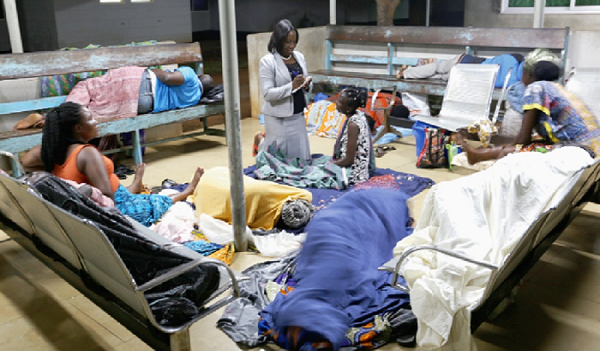
The government has begun piloting a national emergency bed management system aimed at addressing Ghana’s persistent “no bed syndrome” in hospitals. Health Minister Kwabena Mintah Akandoh said the system is designed to provide authorities with real-time information on available hospital beds and the number of patients occupying emergency spaces.
Speaking on Joy News’ PM Express on Wednesday, Mr Akandoh disclosed that a command centre has been established at the Ridge Hospital to coordinate the initiative. “Regarding the bed management system, we have started the pilot. We have the command centre at Ridge Hospital,” he said.
According to the minister, the system enables him to monitor emergency bed availability from his office. “I have a screen in my office, so that if Korle-Bu says there’s no bed, I’m able to see how many beds are available, how many patients are in the emergency,” he explained.
The pilot currently covers selected regional and teaching hospitals. The system is also designed to monitor how long patients remain in emergency units, allowing authorities to investigate prolonged stays, particularly when hospitals report a lack of available beds.
“If you’ve been there for more than 24 hours, and they see you are still there, and they say there is no bed. I will be able to ask questions because there’s a whole command centre in charge of that,” Mr Akandoh said. He stressed that the initiative is not intended to create additional beds but to improve the management of existing capacity.
“So this system will not necessarily add more beds, but it will help us to manage the scarce resources, so that one patient will not be on one bed at emergency for more hours or another,” he said. The government is also expanding emergency capacity at major health facilities, including Korle-Bu Teaching Hospital, Komfo Anokye Teaching Hospital, Tamale Teaching Hospital and the 37 Military Hospital.
At Korle-Bu, Mr Akandoh said the emergency unit currently has about 67 beds, despite the hospital having more than 1,000 beds overall. He added that a 400-bed facility is being constructed as part of a broader redevelopment project. “The contractor is on site as I speak to you now. So we call it a hospital within a hospital,” he said.
The minister said teaching and regional hospitals participating in the pilot have already been integrated into the system. Beds have also been fitted with barcodes, while designated commanders at each facility are responsible for updating the system with real-time data.
“Yes, the beds have barcodes, and there are commanders at each facility to be putting the data in at every moment,” he said. The ambulance service has also been integrated into the system to help determine the most appropriate facilities to which patients should be transported.
Mr Akandoh said more than 200 ambulances are currently operational after the government insured its ambulance fleet in 2025. He added that plans are underway to procure 100 additional ambulances in 2027 to replenish the fleet.
“We are going to add 100 brand-new vehicles,” he said.

