

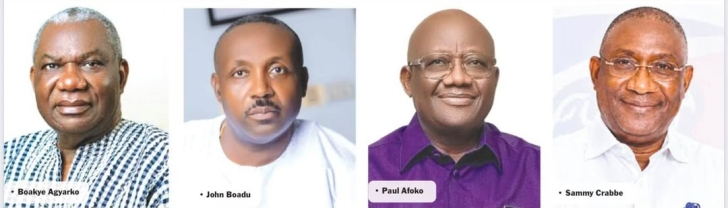
Former General Secretary of the New Patriotic Party (NPP), John Boadu, is currently leading the race for National Chairman. Incumbent General Secretary Justin Kodua Frimpong and former Greater Accra Regional Minister Daniel Nii Kwartei Titus Glover are also in the lead in their respective contests, according to the latest poll conducted by Global InfoAnalytics.
This final wave of the poll was carried out from September 24 to 28, 2026, surveying 3,263 NPP delegates across all 16 regions using the party’s 2026 constituencies register. Global InfoAnalytics reported that the survey utilised Computer Assisted Telephone Interviews (CATI) and achieved a response rate of over 80% for the calls placed. The poll has a confidence level of 98% and a margin of error of plus or minus 1.35 percentage points.
Boadu leads chairmanship race
In the National Chairman contest, Mr Boadu secured 48% support, placing him 10 percentage points ahead of former Energy Minister Boakye Agyarko, who recorded 38%. Former National Chairman Paul Afoko followed with 12%, while Sammy Crabbe polled 2%.
Trend data from the poll showed Mr Boadu’s support declining slightly from 51% on September 2 to 48% in the final wave. Mr Agyarko, meanwhile, rose to 38% on September 17 and maintained that level through the final survey.
The survey also examined the qualities delegates associate with their preferred National Chairman, including the ability to unite the party, enforce discipline, demonstrate grassroots credentials and project a strong personality. Mr Boadu recorded the highest association across all four attributes, with 30% linking him to party unity, 23% to discipline, 25% to grassroots credentials and 23% to a strong personality.
Kodua leads General Secretary race
Incumbent General Secretary Justin Kodua Frimpong recorded 71% in the final wave of the General Secretary contest. He was followed by Sylvester Tetteh with 17%, while Eugene Boakye Antwi and Charles Dwamena each recorded 6%. Mr Kodua’s support had reached 86% on September 17 before falling to 71% in the final survey. The General Secretary election will be contested by four candidates, with Mr Kodua seeking re-election against Mr Tetteh, Mr Antwi and Mr Dwamena.
Titus Glover leads organiser race
Former Greater Accra Regional Minister Daniel Nii Kwartei Titus Glover led the National Organiser contest with 56%, according to the poll. Ali Maiga followed with 23%, while Daniel Agyenim Boateng recorded 6%. Emmanuel Korsi Bodja and Kwame A. Prempeh each polled 5%, while Archibald Korletey Gamor and Nana Kwadjo Agyei Yeboah each recorded 2%. The poll comes ahead of the NPP’s national executive elections scheduled for October 3, 2026. The party has confirmed nine national executive positions will be contested.
Other contests
In the Vice Chairman race, Nana Akomea and Henry Nana Boakye were tied at 19% each. Mustapha Abdul-Hamid and Kojo Fosu Boadu followed with 17% apiece, while the remaining candidates collectively secured 26%. For the National Treasurer position, Alfred Kojo Thompson emerged as the leading candidate with 36%, followed by Collins Nuntwiri Nuamah with 28% and Tahiru Issahaku Moomin with 20%. Ahmed Ruka Saida polled 11%, while Kwaku Nkansa Paani recorded 6%.
In the National Youth Organiser contest, Abanga Fuseini Yakubu topped the poll with 45%, followed by Clement Opoku Gyamfi at 22% and Michael Osei Boateng at 14%. Alfred Kumi Ababio and Vera Oye Bram-Larbi each secured 7%, while Chris Lloyd Nii Kwei Asamoah recorded 4%. Mavis Hawa Koomson led the National Women’s Organiser race with 62%, while Hajia Safia Mohammed and Perpetual Akua Akwada each received 19%.
The poll offers a snapshot of delegate preferences ahead of the October 3 elections. It also shows a 10-percentage-point gap between Mr Boadu and Mr Agyarko in the chairmanship contest. According to Global InfoAnalytics, the latest findings follow an earlier survey conducted in August, which likewise placed Mr Boadu, Mr Kodua and Mr Glover ahead in their respective contests. However, the August survey recorded significantly higher levels of undecided respondents.

