
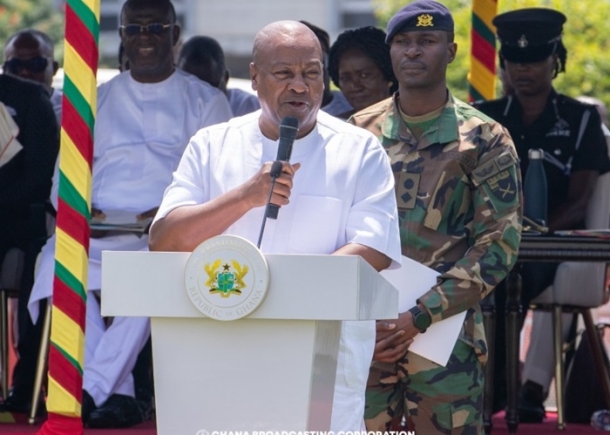
President John Dramani Mahama has announced plans to increase emergency bed capacity at four major hospitals across the country to at least 10 per cent of their functional bed capacity as part of measures to tackle Ghana’s persistent No-Bed Syndrome. Speaking at the 68th Annual General Conference of the Ghana Medical Association on Friday, November 6, 2026, President Mahama disclosed that expansion works would commence next year at the Accident and Emergency Centres of Korle Bu Teaching Hospital, Komfo Anokye Teaching Hospital, Tamale Teaching Hospital and the 37 Military Hospital.
He explained that the initiative would be accompanied by the recruitment and deployment of additional medical personnel, as well as the provision of essential equipment, oxygen and other medical supplies to ensure the expanded facilities are adequately equipped and fully operational. At Korle Bu Teaching Hospital, for instance, achieving the target would require increasing the current emergency bed capacity from 65 to at least 150 beds, more than doubling the existing number.
“We are therefore implementing measures to expand emergency bed capacity to at least 10 per cent of each facility’s functional bed capacity,” the President stated. While preparations for the expansion projects are ongoing, Mr Mahama announced the immediate opening of the Ghana Armed Forces Critical Care and Emergency Hospital to the general public.
“Indeed, it is opening today, and from today, the facility will start receiving patients,” he said, noting that the hospital would provide additional emergency care capacity, particularly during periods of increased demand.
The President further emphasised that healthcare facilities must not deny patients in critical condition medical attention simply because of a shortage of available beds. He stressed that every critically ill patient who arrives at a hospital must receive an initial assessment, regardless of the facility’s bed availability.
“When a patient arrives in critical condition, we cannot simply say, ‘No bed, no bed, go somewhere else.’ At the very least, the patient must be assessed,” he said. He added that hospitals unable to provide the necessary definitive treatment must first stabilise patients within their available capacity before facilitating their transfer to facilities capable of delivering the required care.
Meanwhile, the government has piloted an Integrated Bed Management and Referral Coordination System to strengthen emergency referrals and improve coordination among healthcare facilities. The initiative involves seven major health facilities and the National Ambulance Service.

