

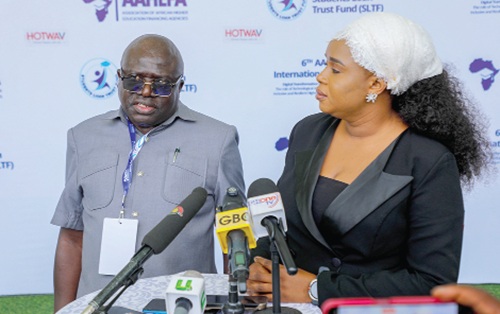
The Chief Executive Officer of the Students Loan Trust Fund (SLTF), Dr. Saadija Shiraz, has announced that the Fund spent approximately GH¢600 million this year on its various portfolios. These included the Students’ Loan, Students Loan Plus, allowances for teacher trainees, the “No Academic Fees” initiative, and free tertiary education for persons with disabilities.
Dr. Shiraz noted, “This year, we have spent quite a substantial amount. Next academic year, the figure will rise significantly—we are projecting close to GH¢800 million.” She made this disclosure while responding to a question at a joint press conference with Dr. John Machayi, President of the Association of African Higher Education Financing Agencies (AHEFA), during the Sixth AAHEFA International Conference held in Accra last Tuesday.
The two-day conference, hosted by SLTF, was themed “Digital transformation in higher education financing: The role of technological advancements in ensuring sustainable, inclusive and resilient higher education financing systems in Africa.” It brought together academics, researchers, policymakers, and heads of higher education institutions from across the continent.
Appreciation
Dr Shiraz attributed the success of the initiatives to the government’s commitment and willingness to provide the necessary support for the programmes. She disclosed that the government provided more than GH¢1 billion in funding last year, noting that the achievement was made possible because President John Dramani Mahama had made education, particularly tertiary education financing, a key component of his Reset Agenda.
On projections for this year, Dr Shiraz said the Students Loan Trust Fund (SLTF) had so far disbursed funds to 169,000 students under the No Academic Fee policy, with the number expected to reach 175,000 by the end of the year. She added that the Trust Fund was leveraging technology to improve the efficiency of its operations and facilitate the delivery of its programmes.
Addressing challenges involving mismatched names and data, the CEO advised beneficiaries to upload their affidavits onto the SLTF portal for verification. She explained that applicants must have their student status confirmed before they could be processed for disbursement.
2026/27 Projection
Dr. Saadija Shiraz revealed that, with a projected 25 percent increase, the Students Loan Trust Fund (SLTF) is aiming to support nearly 200,000 beneficiaries in the 2026–2027 academic year. “We are also expecting close to 80,000 loan applications. Altogether, next academic year alone, our loan initiatives will reach about 300,000 beneficiaries. This is particularly significant as we will be restructuring and reintroducing our digital product loan scheme, enabling students to access financing for digital tools,” she explained.
She further noted that starting this academic year, the Trust Fund’s loan systems will be fully digitalised, allowing students to sign loan agreements online and making access to financing much more seamless.
Education funding
For his part, Dr Machayi urged African governments to regard investment in higher education as an investment in human capital development. He said student financing agencies had a responsibility to support the development of skills that meet the needs of their respective countries, stressing the need to produce graduates who would contribute meaningfully to national development.
“The responsibility is with the student financing agencies to finance the skills that are required in the country. We need to churn out graduates who are assets to our respective governments,” he said. Dr Machayi also recognised the important role of technology in advancing student financing, noting that data remained at the heart of effective technological solutions. He called for deeper discussions on data and statistics, emphasising their importance in shaping policies and improving decision-making. “We need deeper conversations around numbers because it is very critical,” he said.

