

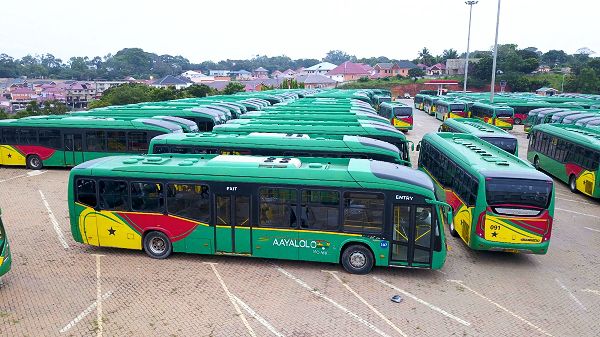
The government will implement a contra-flow arrangement for Aayalolo bus services today, Tuesday, September 29, on selected major routes leading into Accra’s Central Business District. This initiative aims to ease congestion during peak hours. It will be active on three major corridors: Amasaman-Accra, Adenta-Accra, and Kasoa-Accra. These routes are some of the busiest commuter corridors into the capital and often experience significant traffic build-up, especially during morning and evening peak times.
Under this new arrangement, Aayalolo buses will be prioritised for long-distance passenger movements into the Central Business District, while commercial vehicles, including trotros, will continue to serve commuters travelling shorter distances along these corridors. The government states that this approach is intended to enhance the efficiency of public transport by ensuring that high-capacity Aayalolo buses carry large numbers of passengers travelling longer distances, thus reducing the number of individual commuters that commercial vehicles need to transport over those routes.
Local Government Minister Mahama Ayariga explained to Citi News that this arrangement is designed to create a clearer division of roles between Aayalolo buses and commercial passenger vehicles. He explained that commuters travelling shorter distances should continue to rely on trotros, which have traditionally served those routes, while Aayalolo buses focus on transporting larger numbers of passengers directly into Accra.
“We want to leave the shorter trips, such as someone travelling from Adenta to Madina, to the trotros. Similarly, someone travelling from Madina to Legon can continue to use the trotros, because they have limited space and are better suited to serving these shorter-distance journeys.
The Aayalolo buses, on the other hand, can carry up to 80 passengers at a time. So, if we move 80 passengers who are travelling directly from Madina to Accra Central onto an Aayalolo bus, we free up space for the trotros to serve passengers making shorter trips. This could allow the trotros to move faster, make more trips, and potentially carry more passengers overall than they do currently.”
Related article….

