
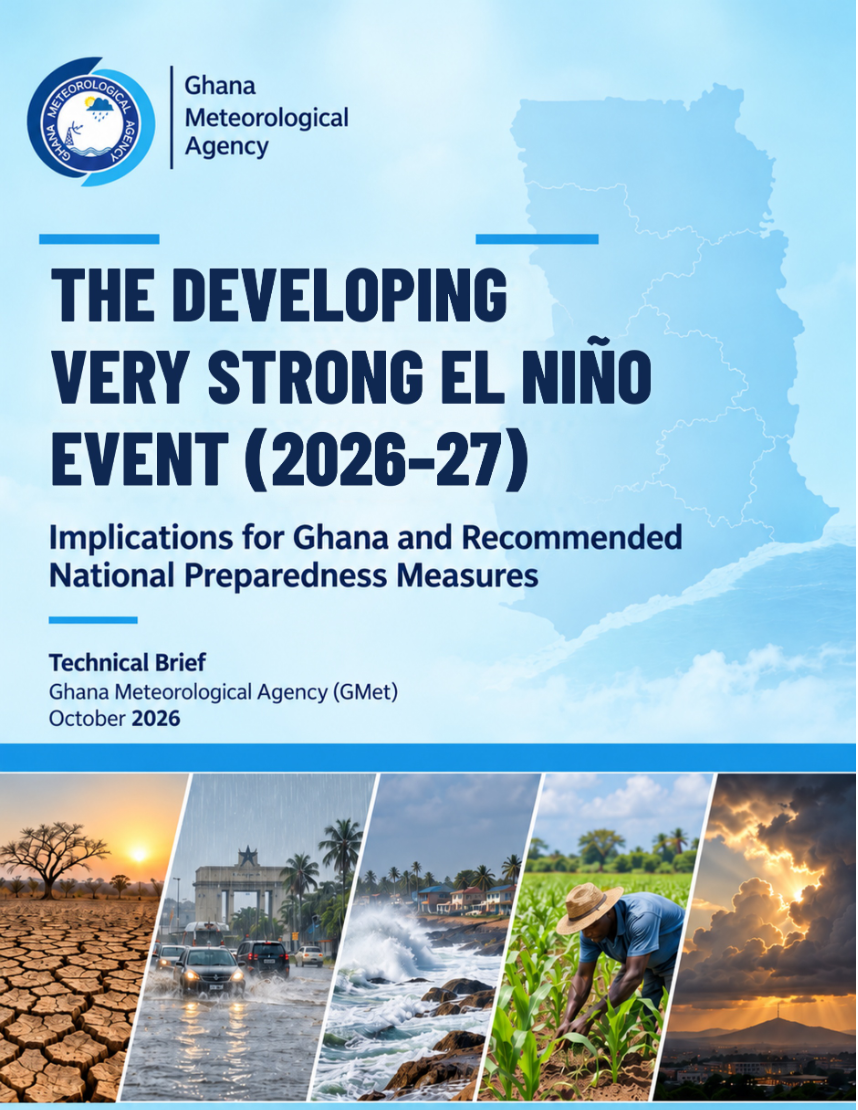
The Ghana Meteorological Agency (GMet) has cautioned that a powerful and intensifying El Niño event could result in a hotter and drier dry season across much of the country, with extreme heat conditions expected to peak between February and April 2027, particularly in northern Ghana. In an advisory issued on Friday, October 30, following a scientific review by its Governing Board on October 27, the agency disclosed that the tropical Pacific was experiencing a very strong El Niño event that was continuing to intensify.
Citing projections from the US National Oceanic and Atmospheric Administration’s Climate Prediction Center, GMet said there was approximately a 96 per cent probability that the phenomenon would reach very strong intensity between November 2026 and January 2027. It added that the weather pattern was highly likely to persist into the early months of 2027.
The agency identified the major risks expected between November and April as unusually high temperatures, reduced rainfall, bushfires, water shortages and increased dust levels. It warned, however, that isolated heavy rainfall and flooding could still occur, even in areas where below-average seasonal rainfall is anticipated. The warning comes four months after the June 29 floods, which, according to the National Disaster Management Organisation (NADMO), claimed 34 lives and displaced 91,046 people nationwide.
GMet’s revised seasonal outlook for October to December also predicts below-normal rainfall across large parts of Ghana. However, above-average rainfall is still expected in some inland areas of Greater Accra and the Central Region, south-western parts of the Volta and Eastern regions, sections of Bono and Savannah, as well as north-western Upper West. Temperatures, meanwhile, are expected to remain above average in most parts of the country.
Lake Volta water levels and electricity generation
On the energy front, GMet explained that electricity generation during the upcoming dry season would depend largely on the volume of water already stored in the Akosombo Dam reservoir, Lake Volta. The agency noted that the reservoir recorded favourable inflows this year, partly due to above-normal rainfall in Burkina Faso and the controlled spillage of the Bagré Dam, which began on August 28. It stressed that the period when El Niño could significantly influence hydropower generation would be the 2027 inflow season, as rainfall patterns during that period would determine electricity generation levels in 2028.
Uncertainty over 2027 rainy seasons
GMet further indicated that the outlook for Ghana’s 2027 rainy seasons remained uncertain, with possible outcomes pointing in different directions. According to the agency, delayed and weaker rainfall could occur if the El Niño phenomenon weakens gradually or sea surface temperatures in the Gulf of Guinea remain relatively cool.
On the other hand, the development of La Niña by the middle of 2027 could increase the likelihood of above-normal rainfall in northern Ghana, potentially resulting in flooding and spillage from the Volta River dams.
Health concerns and heat-related risks
The agency also warned that the usual dry-season risk of meningitis outbreaks in northern Ghana could be worsened by extreme heat and dry conditions. However, it clarified that meningitis risk should not be directly attributed to El Niño. The warning follows a meningitis alert issued by the Ministry of Health in January during the previous dry season.
GMet, in collaboration with the Ghana Health Service, is expected to issue heat-related advisories, particularly targeting vulnerable groups such as older people, young children, outdoor workers, individuals living with chronic illnesses and residents of densely populated urban communities.
Call for a national El Niño preparedness task force
As part of measures to mitigate the potential impact, GMet has proposed the establishment of a National El Niño and Dry-Season Preparedness Task Force to coordinate the country’s response. The proposed body would bring together key ministries responsible for food and agriculture, health, energy, water resources, local government and finance, alongside the Volta River Authority. The task force is expected to report to Cabinet monthly throughout the peak risk period.
GMet has also recommended the early distribution of drought-resistant seeds and meningitis vaccines, the replenishment of NADMO’s emergency relief supplies and the implementation of a nationwide public education campaign to raise awareness of the anticipated weather conditions.
Lessons from previous El Niño events
Ghana has experienced several significant El Niño episodes in the past, including the very strong events of 1982/83 and 1997/98, both of which were followed by electricity rationing. Another notable occurrence was recorded in 2015/16. During the moderate El Niño event of 2023/24, Ghana’s cocoa production reportedly declined by an estimated 20 per cent. GMet has indicated that it will release updated forecasts for the country’s 2027 rainy seasons early next year to provide further guidance for planning and preparedness.

