
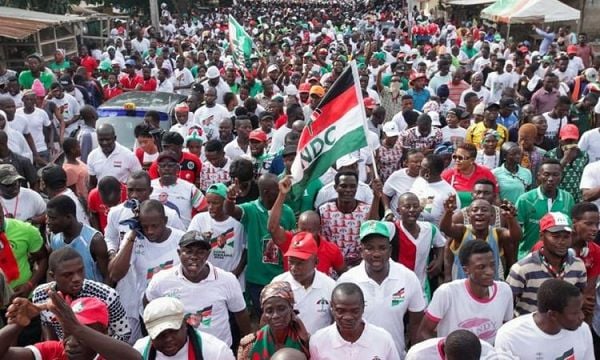
The governing National Democratic Congress (NDC) has completed what could be considered the first and perhaps most crucial stage of its preparations for the 2028 general elections.
At first glance, the exercise appeared relatively uneventful, with no national-level figures directly contesting. However, from the perspective of party organisation and electoral sociology, the process offered significant insights into the party’s internal dynamics. Rather than a fiercely contested election, the exercise appeared to be more about consolidating the party’s structures and reinforcing internal cohesion.
The incidents of ballot-box snatching and machete-wielding violence that once marred constituency-level elections seem to be gradually declining. Reports from several polling centres indicate that the elections were largely peaceful, with the Electoral Commission (EC) overseeing the process and party supporters observing proceedings.
Beyond the relative calm, however, the underlying political dynamics made the exercise particularly noteworthy. Although no prominent national figures were directly on the ballot, the various contests took on broader political significance. Chairmanship races became indirect battlegrounds for competing national interests, as delegates and observers interpreted the outcomes through the lens of alliances with ministers, Members of Parliament (MPs) and supporters of potential flag-bearer aspirants positioning themselves ahead of the party’s eventual succession contest after President Mahama.
This reflects a familiar dilemma within governing parties: while leaders publicly emphasise unity, competing factions quietly begin positioning themselves to influence the distribution of power in the future.
At the constituency level, executive members wield considerable influence through their control of polling station registers and their ability to mobilise grassroots supporters. As a result, these local party officials represent an important source of political influence and become valuable assets in the broader contest for future leadership and power within the NDC.
Anomaly of consensus
One of the most notable outcomes of the weekend’s exercise was that all executive positions in 24 constituencies were uncontested, eliminating the need for voting. This development could point to two contrasting realities: a high degree of internal consensus and behind-the-scenes negotiations that resolved potential disputes before they reached the ballot, or a troubling narrowing of democratic competition, where entrenched local power brokers have become so dominant that challengers see little value in contesting them.
The key question, therefore, is whether the absence of competition reflects genuine unity or widespread apathy, internal cohesion or subtle coercion. These possibilities warrant closer examination.
Developments in three constituencies offer insight into the different political dynamics shaping the exercise at the local level.
In Odododiodoo, a constituency regarded as an important indicator of Ga-Dangme urban politics, incumbent chairman Paul Oblie Laryea secured re-election. Reflecting on the party’s electoral performance, he said the constituency had increased its voting margin from 5,000 to 14,000 and expressed confidence that the achievement could be replicated in the 2028 general elections.
The statement highlights a significant shift in the expectations placed on constituency executives. Their performance is increasingly measured not merely by their commitment to the party, but also by their ability to mobilise voters and deliver stronger electoral margins. In effect, constituency chairmen are adopting the language of electoral analysts, with their political credibility increasingly tied to measurable voting outcomes.
This is the professionalisation of the grassroots.
In Ketu South, widely regarded as one of the NDC’s most dependable electoral strongholds, the constituency elections were held on Friday and featured intense competition, underscoring the political importance of maintaining control over the party’s formidable voter base.
Ahorlu Ferguson Kwabla won the chairmanship race with 946 votes in a four-candidate contest, defeating Dzila Bright, who polled 525 votes, Kelie Elolo White, who secured 497, and Amedorme Sylvanus Yao, who received 433 votes. Abelia Seth Kwasi won the vice-chairmanship with 1,075 votes, while Zigah Reginald Edem Kodzo secured the secretary position with a decisive 1,524 votes.
Notably, voting in Ketu South took place a day earlier, on October 23, following a decision by the party’s national leadership to reschedule the exercise to avoid a clash with the final funeral rites of Torgbui Addo, the Paramount Chief of Klikor.
The adjustment, though administrative in nature, highlights the importance of cultural sensitivity in Ghanaian politics. It also reflects the need for political parties in government to balance their organisational schedules with traditional institutions, particularly chieftaincy, an area where previous administrations have sometimes struggled to strike the right balance.
In Tamale North, another key constituency in the NDC’s northern stronghold, incumbent chairman Nayi Alhassan, popularly known as Ngbagu, retained his position with 518 votes. He defeated Salifu Mohammed, who obtained 352 votes, and Abdul Halim Wayo Issahaku, who polled 147.
His re-election suggests that established community connections and personal networks continue to play an influential role in northern politics, where local relationships can be as important as formal party structures.
However, the elections were not without controversy. In Atwima Kwanwoma in the Ashanti Region, where the NDC faces a challenging political environment against the opposition, some aggrieved delegates alleged that their names had been removed from the voters’ register. Reports also indicated that some invoked curses against the party’s executive members in protest.
The incident highlights the continuing sensitivity surrounding voter registration in internal party elections, where control of the delegates’ register can determine who participates in the process. It also reflects the intersection of electoral disputes with traditional spiritual beliefs in Ghanaian political culture.
Anticipating possible disagreements, the NDC’s Deputy Director of Elections, Rashid Tanko-Computer, stressed that the party had established formal mechanisms for addressing such complaints.
He explained that a team at the party’s national headquarters was responsible for handling matters of this nature.
We have an election committee.
If you have any issue, you appeal to the election task force,” he said.
Mr Tanko-Computer’s assertion that no issue had yet been escalated to the national level suggests either efficient local resolution or, more likely, a strategic containment of disputes before they acquire national visibility.
Building pyramid from base
What the NDC has done is classic party institutionalism.
While the public and media focus obsessively on who will succeed President Mahama, the party is building the pyramid from the base. The constituency party official is the polling station register, the branch mobiliser, the funeral attendee, the arbiter of local grievances.
Two hundred and seventy-six such officials control the party.
If the 2024 victory was about capturing disaffection with the previous regime, 2028 will be about proving that the NDC can institutionalise power without atrophying into complacency. Last weekend’s largely peaceful, largely bureaucratic exercise was the first test of that.
For scholars of comparative party politics, the NDC’s internal process offers a case study in how dominant parties in Africa attempt to manage succession anxieties and grassroots expectations simultaneously — not through grand ideological congresses, but through the quiet, unglamorous renewal of the constituency executive.

