
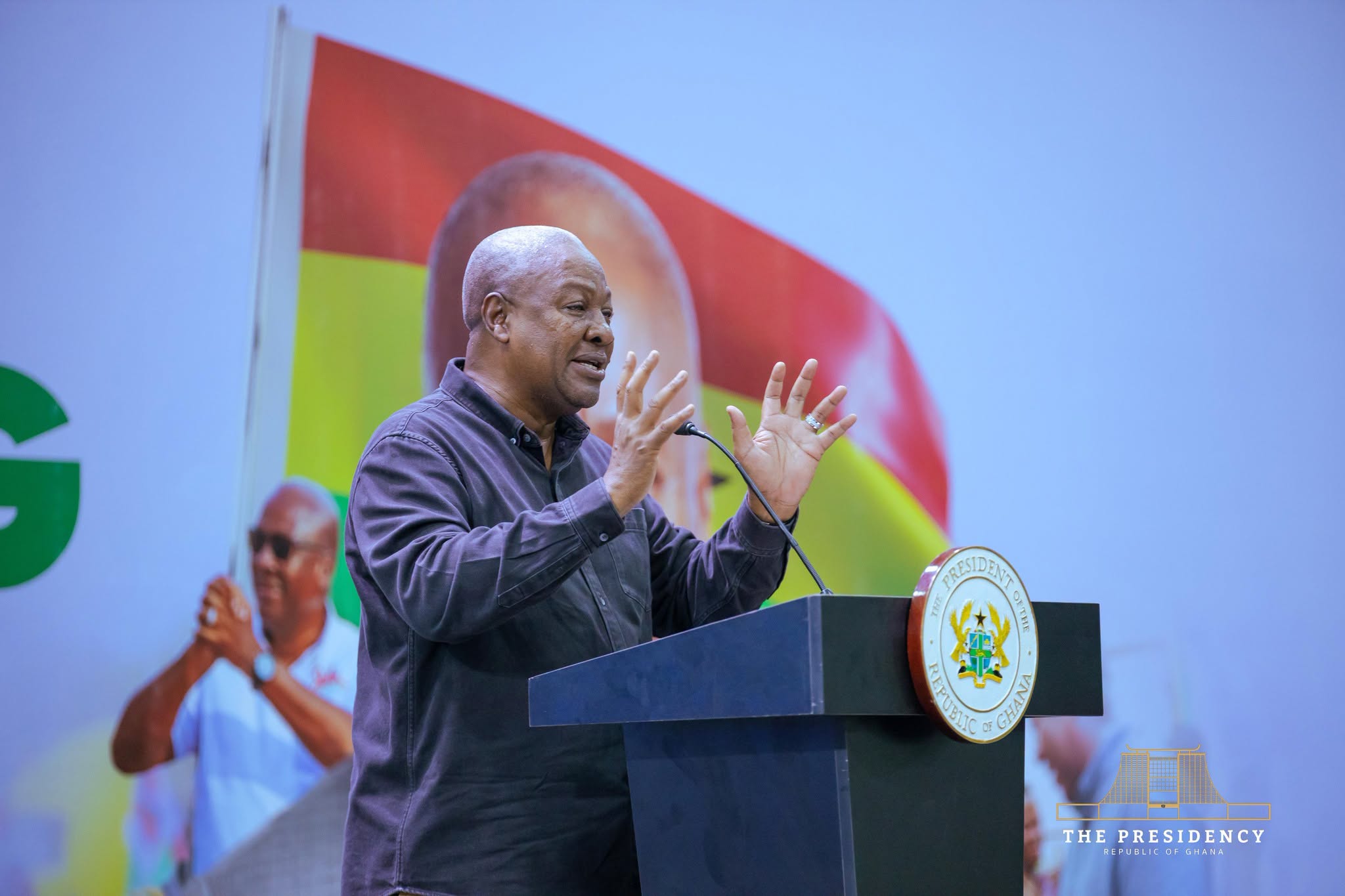
President John Dramani Mahama has welcomed UK Prime Minister Andy Burnham’s recognition of the historical injustices associated with the Transatlantic Slave Trade, while calling for a formal apology and a structured international dialogue on reparatory justice. In a statement issued by the Presidency on Sunday, November 1, 2026, President Mahama, who serves as the African Union Champion on Reparations and Chair of the Global Advisory Panel on Reparatory Justice, described the British Prime Minister’s remarks as a courageous and sincere acknowledgement of the United Kingdom’s historical involvement in slavery and colonialism.
The President’s response follows the UK’s expressed willingness to consider a formal apology and comes in the wake of the historic adoption of a Ghana-led United Nations resolution recognising the transatlantic slave trade and racialised chattel enslavement as the gravest crime against humanity. The Presidency described the development as a significant milestone in the global campaign for reparatory justice.
“We consider this a watershed moment and a refreshing contribution to the growing international consensus on reparatory justice,” the statement noted. President Mahama emphasised Ghana’s unique historical connection to the slave trade, pointing out that the country is home to the world’s largest concentration of slave castles and forts, including Cape Coast Castle, Elmina Castle and Christiansborg Castle. These sites witnessed the dehumanisation and forced transportation of millions of Africans across the Atlantic.
While acknowledging that a formal apology would not reverse the suffering and injustices endured by generations of Africans, he maintained that such an action would represent an important break from historical denial and create an opportunity for meaningful reconciliation and healing.
He also called for a structured and sincere international dialogue involving the African Union (AU), the Caribbean Community (CARICOM), the African diaspora and countries that participated in the transatlantic system of chattel enslavement. As part of his proposal, President Mahama outlined a five-point framework to guide discussions on reparatory justice.
The framework includes a formal apology; a coordinated international commitment to combating systemic racism and Afrophobia; targeted investments in education, science, youth empowerment, climate resilience and healthcare; the restitution of stolen cultural artefacts and heritage; and strategic development partnerships aimed at addressing structural poverty and inequalities within the global economic system.
The statement acknowledged that countries and stakeholders involved in the discussions might hold differing positions on the scope and implementation of reparatory justice. “We recognise, as our partners do, that our perspectives on reparatory justice may not be identical. There are clearly areas of strong disagreement, but such differences must not deter us from the shared objective,” it added.
The Ghanaian government also commended Prime Minister Burnham and UK Foreign Secretary Ed Miliband for what it described as their moral leadership, stressing that acknowledging historical injustices and confronting uncomfortable truths are important acts of statesmanship.
“We have waited too long for this day; let our generation of leaders be remembered for our courage to confront the past honestly and seek the healing and repair that will put this dark chapter of human history behind us and guarantee non-repetition,” the statement read.

