

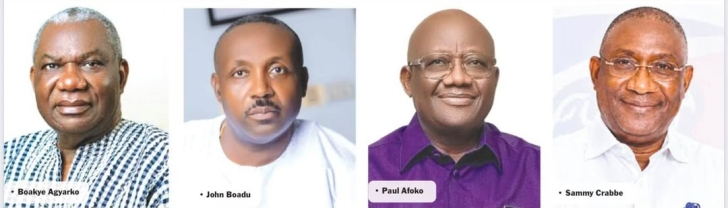
Former Energy Minister Boakye Agyarko, two former national executives and a former National Chairman seeking a return to the position are set for a four-way contest for the national chairmanship of the opposition New Patriotic Party (NPP), as 47 aspirants prepare to compete for nine national party positions. The other chairmanship contenders are John Boadu, a former General Secretary of the party; Sammy Crabbe, a former National Vice-Chairman; and Paul Afoko, who previously served as National Chairman.
The contest comes as the party undertakes a restructuring exercise ahead of the 2028 general elections. The party’s delegates conference, scheduled for Saturday, October 3, in Kumasi, will bring to a close an intense campaign that has energised the party’s grassroots as it prepares for its broader electoral ambitions in 2028. The candidates have sought to highlight various factors in their campaigns, including party loyalty, experience, vision and strategy. Supporters of Mr Agyarko, however, have pointed to his moderate disposition and perceived independence from internal party factions as key strengths.
A former banker with strong ties to the business community, Mr Agyarko is entering the chairmanship race for national office for the first time. His supporters argue that his previous tenure as Energy Minister leaves him with limited political baggage. Mr Afoko served as NPP National Chairman until 2015, when a recommendation by the party’s internal Disciplinary Committee brought his tenure to an end. Mr Boadu, meanwhile, lost his position as General Secretary at the party’s most recent congress to the incumbent, Justin Kodua Frimpong.
Mr Crabbe, like Mr Afoko, also left his position following a recommendation by the party’s internal Disciplinary Committee in 2015. With about 16 days remaining before the polls, all 47 aspirants have been cleared to contest the nine national positions, including three additional slots for Vice-Chairpersons.
But the national chairperson position, being sought by the four stalwarts, remains the most interesting contest. Each of the four remaining contestants comes with a long history of involvement in the party’s politics, with delegates confronted with choosing which of them has the right mix of administrative skills and values, not only to ensure a smooth day-to-day running of the party’s operations, but also to reposition it and work closely with the flag bearer towards the 2028 elections.
Mr Agyarko throws himself into the mix to serve the party once again after he was changed as the Minister of Energy in August 2018, while Mr Boadu has been National Organiser, a Deputy General Secretary and then General Secretary before losing to Mr Kodua Frimpong at the National Delegates Conference on July 16, 2022, at the Accra Sports Stadium.
Mr Afoko defied the odds to beat Stephen Ntim and then incumbent, Jake Obetsebi Lamptey, now deceased, in the 2014 contest. The next party chairman, however, may have to understand both the extent of the defeat at the 2024 elections and some of the deeper shifts in public sentiment well captured by the Afrobarometer survey.
The goal will be to have a credible plan that rebuilds trust and wins back the people the party lost in 2024. According to political scientist Dr John Osae-Kwapong, the ability to unify the party, including those whose disaffection led to the kind of apathy witnessed in areas considered as party strongholds, would be key.
He maintained that every political party must be disciplined. “However, to have discipline requires the enforcement of party rules without fear or favour. This is, at its core, a call for a strong party chairman — someone who can apply the party’s constitution and internal processes evenly and fairly, regardless of who is involved,” he stated in comments to the Daily Graphic.
Dr Osae-Kwapong stressed the need for the new party chairman to be able to work closely with the flag bearer in a way that would avoid the perception of “party versus flag bearer team”. “A genuine sense of shared purpose is needed so that the party and the candidate do not create a situation of rivalry. They must constantly remember that they are a team working towards one goal — winning the 2028 election,” he stated.
Decision
The Head of the Department of Political Science at the University for Development Studies, Dr Gbensuglo Alidu Bukari, says the NPP needs a national chairman capable of uniting the party while also building a strong campaign structure ahead of the 2028 elections.
“In that sense, Agyarko’s strategic background may give him an edge, but Afoko’s name recognition and Boadu’s organisational clout cannot be underestimated. It will be a competitive race right to the end,” he said.
According to Dr Bukari, Mr Agyarko occupies a relatively centrist position within the contest and could potentially emerge as a surprise candidate. He said Agyarko’s perceived neutrality and reputation as a less polarising figure could make him an attractive compromise for delegates seeking to move beyond internal factional divisions.
Dr Bukari further suggested that if the contest becomes fragmented and none of the candidates secures an early majority, Mr Agyarko could emerge as a consensus candidate.
Mr Agyarko also brings significant experience to the race, having served as a minister and spent many years in the banking sector. Dr Bukari noted that his public-sector background, private-sector experience, communication skills and extensive networks contribute to his profile as a candidate who presents himself as a statesmanlike figure.
Paul Afoko
Dr Bukari considers Mr Afoko a strong contender, but not necessarily the frontrunner. “His name recognition and previous tenure as chairman give him a solid foundation,” Dr Bukari said. But his experience is a double-edged sword; on one hand, it damaged his reputation among party faithful, and on the other hand offering him institutional memory and a clear understanding of the party’s machinery. “He knows the grassroots, the structures, and the pain points.
That is an advantage.
However, Dr Bukari noted that Mr Agyarko’s previous tenure was also characterised by internal disagreements and allegations of strained communication with the party’s leadership. He said some delegates could therefore regard him as a figure associated with the past rather than as a leader offering a new direction.
“His experience may help him rally those who feel marginalised, but it also gives his opponents grounds to question his ability to unite the party,” Dr Bukari said.
He also dismissed suggestions that Mr Afoko’s northern background would significantly disadvantage his chances, even if the party chooses a flag bearer from the same part of the country.
According to Dr Bukari, the NPP has, particularly in recent elections under the Fourth Republic, placed greater emphasis on competence and loyalty than on ethnic considerations.
“Moreover, the flag bearer and the chairman serve different roles; the chairman is the administrator of the party, while the flag bearer is the public face of the campaign,” he said, arguing that delegates were capable of distinguishing between the two positions.
Dr Bukari, however, noted that having both the national chairman and flag bearer from the northern part of the country could, instead, be presented as an indication of national inclusion rather than a disadvantage.
John Boadu
Mr Boadu has a long history within the NPP, having served as national organiser before becoming General Secretary. He boasts experience, which positions him to run an effective campaign to return the party to power through strengthening the party’s internal security ahead of future elections. Mr Crabbe believes that rebuilding the party’s coalition must form part of the NPP’s strategy ahead of the 2028 general election. He is seeking the position on the basis that the NPP must look beyond its traditional electoral strongholds and deliberately rebuild relationships with groups and communities that form part of Ghana’s wider political and professional landscape.
History
It is his contention that the party’s ability to rebuild those relationships would be critical to its prospects of returning to power in 2028. He argues that the NPP needs to reform its internal structures and rebuild the coalition that helped it to win the 2016 and 2020 elections if it is to mount a successful campaign in 2028. Mr Crabbe believes that the NPP’s 2024 electoral defeat exposed systemic weaknesses that require institutional solutions, including sustainable funding and stronger party structures and moving away from depending on individuals who can personally finance its activities. He said the NPP currently relied heavily on what he described as “episodic funding”, where resources became available at particular periods rather than through a consistent financial system.
Ballot
But if the position one places on the ballot paper is anything to go by, then John Boadu will be number one, Sammy Crabbe in second position, Paul Afoko takes the third slot, with Boakye Agyarko occupying the fourth spot.

